

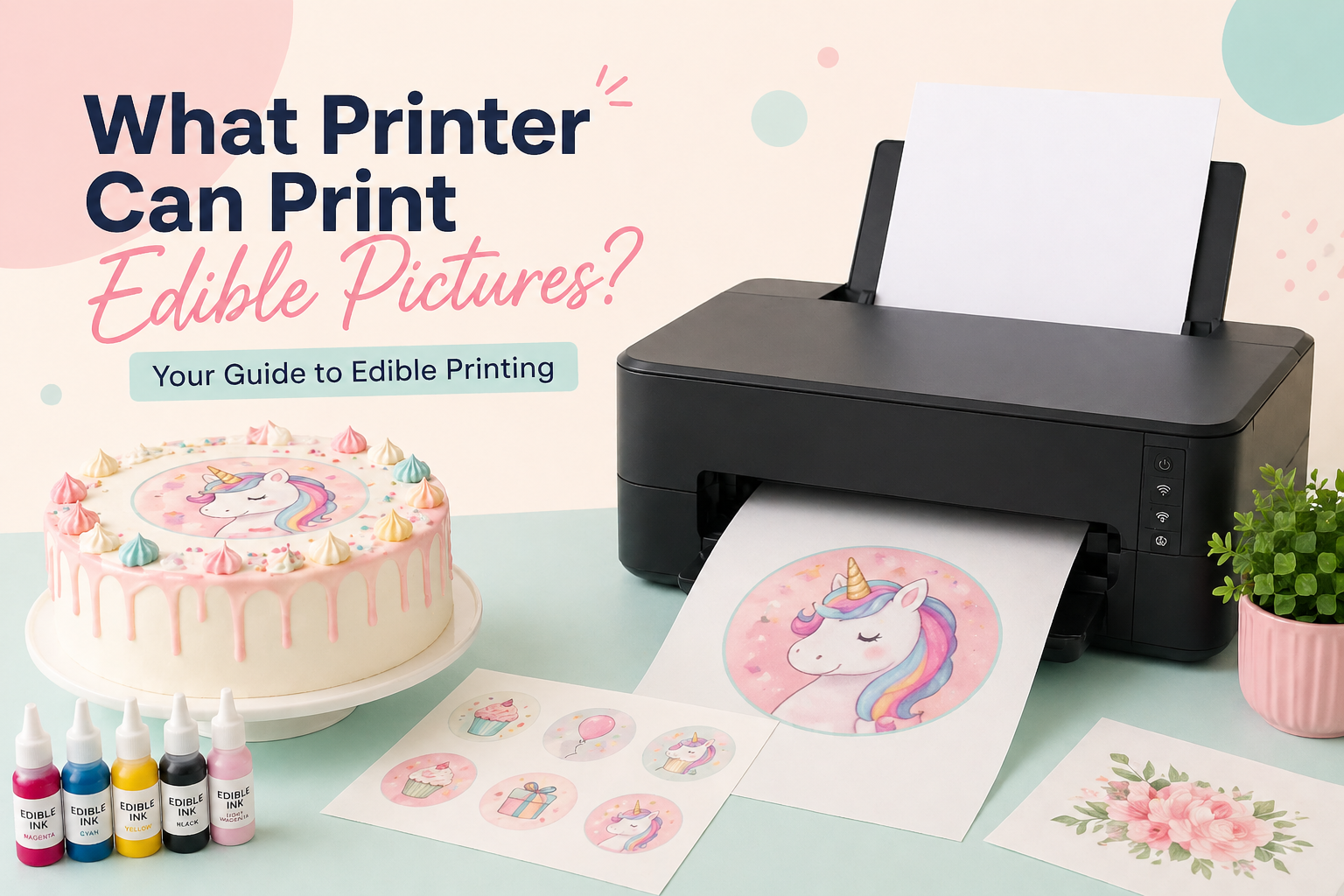
What printer can print edible pictures?
Home / Blog / What Printer Can Print Edible Pictures?
What Printer Can
Print Edible Pictures?
Whether you are curious about how edible printing works, thinking about buying your own edible printer, or looking for the easiest way to get a custom edible cake topper — this is the complete guide you need.
So — What Printer Can Actually Print Edible Pictures?
Modified inkjet printers are used to print edible pictures. Standard consumer inkjet printers — most commonly from Canon and Epson — are converted into edible image printers by replacing their standard ink cartridges with food-grade edible ink cartridges and using edible frosting sheets or wafer paper as the print medium instead of regular paper.
The printer itself is not fundamentally different — what makes it an "edible printer" is the combination of FDA-compliant edible ink and food-safe print media. The result is a vibrant, photo-quality image that is completely safe to eat and place directly on any frosted cake.
How Does an Edible Image Printer Actually Work?
The technology behind edible image printing is simpler than most people expect. An edible printer operates on the exact same mechanical principles as any standard inkjet printer — it fires tiny droplets of ink through microscopic nozzles onto a surface using either thermal or piezoelectric technology. The critical differences are in what goes into the printer and what goes through it.
The ink: Standard petroleum or dye-based printer inks are replaced entirely with food-grade edible ink made from FDA-approved food colorings, purified water, glycerin, and sugar. These cartridges are designed specifically for food use and are never interchangeable with standard inks.
The media: Instead of paper, the printer feeds through a frosting sheet or wafer paper — a thin, food-safe substrate made from sugar, starch, and glycerin. The frosting sheet accepts the edible ink just as paper would accept regular ink, producing a sharp, full-color image.
The color system: Edible printers use the standard CMYK color model (Cyan, Magenta, Yellow, and Black) — the same four-color system used in all physical printing. Each cartridge slot contains a different food-safe dye that combines to reproduce the full visible color spectrum.
Dedicated use only: A printer used for edible printing must never contain or have previously contained standard non-edible inks. Professional edible printing operations use entirely separate, dedicated machines that have only ever been loaded with food-grade edible ink cartridges.
Which Printer Brands Are Used for Edible Printing?
Not all inkjet printers are compatible with edible ink cartridges. The edible ink industry has standardized around a small number of models — primarily from Canon and Epson — because their cartridge systems, print heads, and ink delivery mechanisms are best suited for adaptation. Here are the most widely used platforms:
Canon PIXMA Series
The most popular platform for edible printing worldwide. The PIXMA MG5720, MG6820, TS6120, and TS9120 are among the most commonly converted models. Canon's individual ink cartridge system makes it ideal — each color is a separate cartridge, reducing waste and cost.
Most PopularEpson Expression & EcoTank
Epson's Expression series (XP-7100, XP-640) and certain EcoTank models are widely used in professional edible printing. Epson's piezoelectric print heads are known for producing exceptionally sharp, detailed image reproduction — particularly for fine lines and small text.
Professional GradePre-Converted Edible Printers
Several specialist brands sell printers that come pre-converted for edible use — the machine is already loaded with edible ink cartridges and tested for food-safe printing. These are popular with home bakers who want a plug-and-play solution without doing the conversion themselves.
Ready to UseHP DeskJet / OfficeJet
Some HP models have edible ink cartridge equivalents available, though compatibility is more limited than Canon or Epson. HP printers are less commonly used in professional edible printing operations due to the smaller range of compatible cartridges on the market.
Limited Support"The printer is just one piece of the puzzle. The quality of your edible image depends equally on the ink, the frosting sheet, and the resolution of the image you print — getting all three right is what produces a truly professional result."— Custom Edible Sheets, Edible Printing Experts
What Is Edible Ink Made Of?
Edible ink is a carefully formulated food-grade liquid that replicates the physical properties of inkjet printer ink while being completely safe for human consumption. Every ingredient must meet FDA food additive regulations. Here is what goes inside a standard edible ink cartridge:
FD&C Certified Food Colorings — the primary pigment source. FDA-approved synthetic dyes including Red 40, Blue 1, Yellow 5, and Yellow 6 form the CMYK color channels. Some formulations use natural alternatives such as beet extract, spirulina, or turmeric.
Purified / Deionized Water — the primary carrier solvent. Deionization removes minerals that could clog print nozzles or interfere with color accuracy in the final print.
Glycerin (Glycerol) — a food-safe humectant that keeps the ink from drying in the cartridge, ensures smooth flow through the print head, and prevents nozzle clogging between uses.
Sugar (Sucrose or Dextrose) — acts as a binder that helps the ink adhere cleanly to the frosting sheet surface without bleeding or spreading beyond the intended pixel boundaries.
Propylene Glycol — a food-grade solvent (FDA GRAS status) that adjusts ink viscosity to match the flow requirements of inkjet print heads, ensuring consistent droplet size and print quality.
Citric Acid — a pH regulator and natural preservative that stabilizes the ink formulation and prevents color degradation over the cartridge's shelf life.
What Do You Print the Edible Image On?
The substrate — the edible "paper" that goes through the printer — is just as important as the ink. There are two main types used in edible printing, each suited to different applications:
Frosting Sheets (Sugar Sheets) — the premium choice for photo and logo printing. Made from sugar, corn syrup, modified starch, glycerin, and sorbitol. Bright white base that produces vivid, saturated colors. Thick, opaque, and flexible — blends seamlessly into buttercream and fondant when applied. This is what Custom Edible Sheets uses for all our custom prints.
Wafer Paper (Rice Paper) — thinner, semi-translucent, and slightly crisp. Made primarily from potato starch and water. Colors appear less saturated than on frosting sheets. Better suited for 3D cake decorations, sugar flowers, and applications where a thinner medium is needed. Not recommended for photo-quality prints.
Which is better for cake toppers? Frosting sheets — every time. The opaque white base acts like a canvas, making colors pop with maximum vibrancy. Wafer paper's translucency means colors appear over whatever frosting is beneath it, making accurate reproduction difficult on anything other than white frosting.
Buying Your Own Printer vs. Using a Printing Service
Which option makes more sense for your situation? Here is the honest comparison.
| Factor | Buying Your Own Printer | Using a Service (like us) |
|---|---|---|
| Upfront cost | ✗ $300–$1,000+ for printer + inks + sheets | ✓ Zero — pay per order only |
| Print quality | ~ Good if maintained correctly | ✓ Professional-grade every time |
| Maintenance | ✗ Regular cleaning, nozzle checks required | ✓ None — handled for you |
| Nozzle clogging risk | ✗ High if not used frequently | ✓ No risk |
| Ink shelf life concern | ✗ Cartridges expire and dry out | ✓ Always fresh ink used |
| Setup complexity | ✗ Moderate — conversion + calibration | ✓ Just upload and order |
| Best for occasional use | ✗ Not cost-effective | ✓ Perfect — no waste |
| Best for daily high volume | ✓ Can be cost-effective at scale | ~ Bulk ordering available |
| Color consistency | ~ Varies with calibration | ✓ Consistent every print |
| Food safety assurance | ~ Depends on your setup | ✓ FDA-compliant guaranteed |
The True Cost of Owning an Edible Printer
Many home bakers and small cake businesses consider buying their own edible printer to save money on orders. Here is an honest breakdown of the actual costs involved — which are often significantly higher than expected:
The break-even reality: For most home bakers and occasional users, buying your own edible printer only becomes cost-effective if you are printing 20+ cake toppers per month consistently. Below that volume, ordering from a professional service is almost always cheaper, faster, and produces better results.
The Biggest Challenges of Home Edible Printing
If you are considering buying your own edible printer, it is important to understand the most common issues that home and small-scale edible printer owners face — these are rarely mentioned in product listings but come up frequently in practice:
Nozzle clogging — the number one problem. Edible ink is more viscous and sugar-based, which means print heads clog much faster than with standard ink — especially if the printer is not used every 2–3 days. Unclogging often requires expensive cleaning cartridges or professional servicing.
Color calibration drift — colors printed at home often look different from what you see on screen due to uncalibrated settings. Getting accurate, consistent color reproduction requires multiple test prints, profile adjustments, and ongoing recalibration as ink levels change.
Frosting sheet feeding errors — frosting sheets are thicker and more flexible than standard paper. Many printers have difficulty feeding them consistently, resulting in jams, misalignment, or sheets being chewed up by the feed mechanism.
Ink expiration — edible ink cartridges have a shelf life of approximately 6–12 months. Infrequent users often find their cartridges have dried out or expired before they are used up, resulting in wasted ink and additional replacement cost.
Voided warranties — converting a standard inkjet printer to edible use typically voids its manufacturer warranty. If the print head fails or the printer malfunctions, repair or replacement costs fall entirely on the owner.
Why Most People Choose a Professional Edible Printing Service
Given the costs, maintenance challenges, and technical complexity of owning an edible printer, the vast majority of home bakers, cake enthusiasts, and even many professional cake decorators choose to order from a dedicated edible image printing service like Custom Edible Sheets instead.
No Equipment Cost
Zero upfront investment. Pay only for what you order — no printer, no ink sets, no frosting sheet packs to buy and store.
Professional Quality
Commercial-grade printers calibrated for perfect color accuracy — consistently sharper and more vibrant than home setups.
Zero Maintenance
No clogged heads, no calibration, no cleaning cycles. Everything is handled on our end before your order is ever printed.
Instant Turnaround
Upload your image, place your order, receive your print in 1–2 business days with free shipping on every order.
Guaranteed Food Safe
Every print uses FDA-compliant edible inks on certified food-safe frosting sheets — with no cross-contamination risk.
Any Design, Any Size
Photos, logos, illustrations, collages — any image, any size from cupcake toppers to full half-sheet cakes.
Frequently Asked Questions About Edible Printers
Can I use any inkjet printer to print edible images?
No. Only specific Canon and Epson inkjet models have compatible edible ink cartridges available. The printer must also be entirely dedicated to edible use — it should never have contained regular non-food ink. Using the wrong printer or mixing edible and standard inks creates a serious food safety risk.
Can I convert my existing home printer for edible printing?
Only if your existing printer is a compatible Canon or Epson model that has edible ink cartridges available for its cartridge type. The printer must be brand new or thoroughly cleaned — any trace of standard ink contamination makes it unsafe for food use. Most food safety experts recommend purchasing a separate dedicated printer rather than converting an existing one.
How long do edible ink cartridges last before expiring?
Most edible ink cartridges have a shelf life of 6–12 months from the manufacture date. Once opened, they should ideally be used within 3–6 months. Cartridges left unused for extended periods can dry out, clog the print head, or produce degraded colors. This is one of the key reasons occasional users find owning a printer less practical than ordering from a service.
Is edible ink really safe to eat?
Yes — when purchased from a reputable supplier, edible ink is made entirely from FDA-approved food-grade ingredients including certified food colorings, glycerin, purified water, and sugar. These are the same colorings used in candy, frosting, and breakfast cereals. The quantity consumed from a single slice of cake is extremely small.
What resolution should I print edible images at?
For the best quality edible prints, your image should be at 300 DPI (dots per inch) at the intended print size. Most modern smartphone photos easily meet this standard. Edible printers are typically set to print at 1200–2400 DPI, but the quality of your source image is the real limiting factor — a low-res image will look blurry regardless of the printer's maximum DPI.
What is the best Canon printer for edible images?
The Canon PIXMA MG5720, MG6820, TS6120, and TS9120 are among the most widely used and recommended models for edible printing. They use individual color ink cartridges (rather than combined cartridges), which makes switching to edible ink cartridges straightforward and reduces per-print ink cost. The TS9120 in particular is favored for its wide format capability and superior color management.
How do professional edible printing services differ from home printing?
Professional services use commercial-grade printers calibrated specifically for food printing, with fresh ink loaded regularly and print heads maintained to a professional standard. This produces noticeably sharper detail, more accurate colors, and more consistent results than home setups — particularly for photographs and complex graphics. Professional services also use premium frosting sheets that produce superior color vibrancy compared to budget alternatives.
Get a Professional Edible Print
Delivered to Your Door
No printer to buy, no ink to manage, no clogged heads to deal with. Just upload your photo or design and receive a stunning, food-safe edible cake topper — printed at professional quality and shipped free in 1–2 business days.
Upload Your Design Now → Browse All Products