

Icing Sheets vs Wafer Paper: What’s the Difference & Which One Should You Choose?
Icing Paper vs Wafer Paper: Everything You Need to Know
Two types of edible paper. Completely different results. Here's how to choose the right one for your cakes, cookies, and custom edible prints — every single time.
The Short Answer
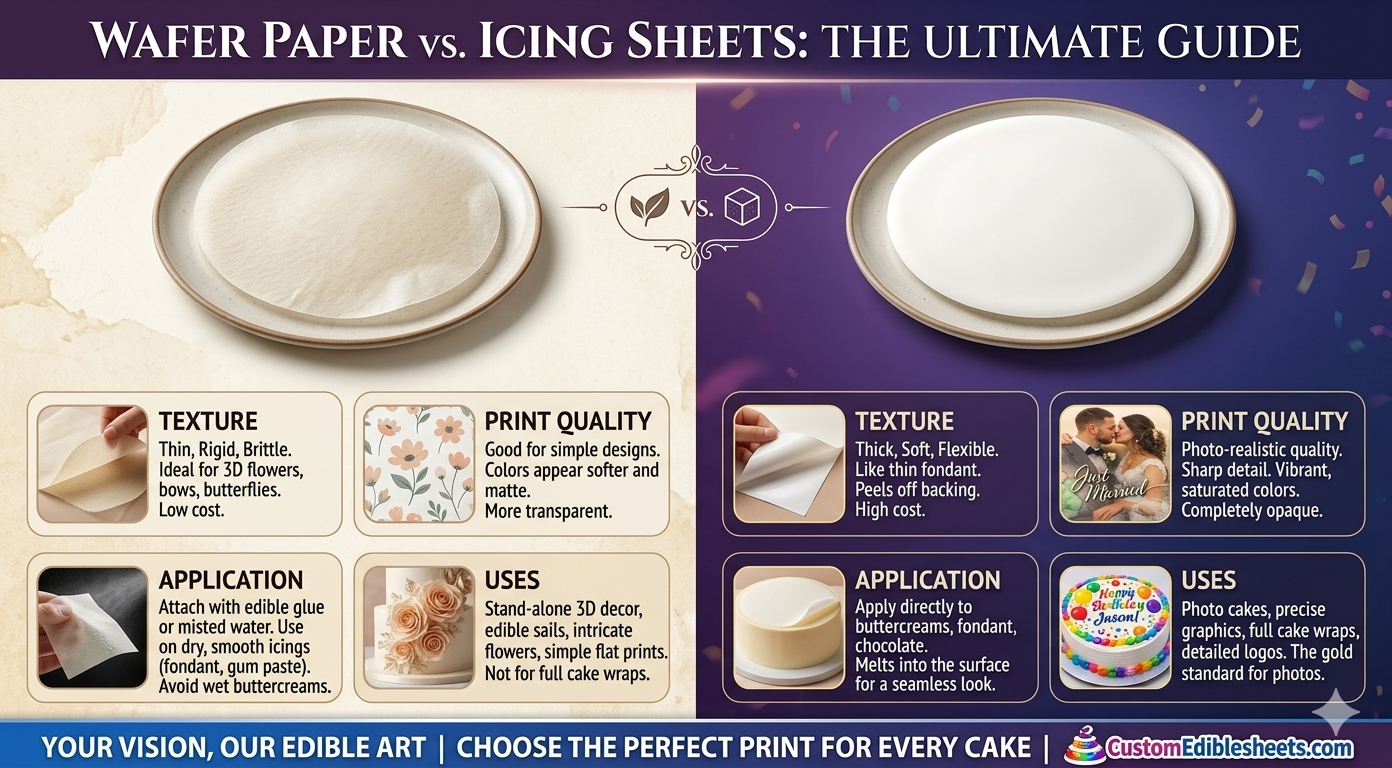
Icing paper (also called frosting sheets or sugar sheets) is the go-to for vivid, photo-quality edible prints — it's smooth, opaque, and slightly sweet. Wafer paper is made from potato starch and is far thinner, nearly tasteless, and perfect for sculptural decorations like flowers, butterflies, and artistic effects. They are not interchangeable — choosing the wrong one can ruin a design.
What Is Icing Paper?
Icing paper — sometimes called frosting sheets, sugar sheets, or edible icing sheets — is a type of edible paper made primarily from sugar, starch, and vegetable shortening. The result is a smooth, opaque, slightly flexible sheet that looks a lot like a thin layer of fondant or matte icing.
Because the surface is bright white and non-porous, it accepts edible food coloring inks exceptionally well. Colors print true-to-life, photographs come out sharp and vivid, and the overall result is a professional, polished finish that instantly elevates any cake or cupcake.
Icing sheets are typically available in full sheet, half sheet, and A4 sizes, and they're the standard choice for any bakery or home baker who wants to print custom edible images for cakes, cookies, macarons, and cupcake toppers.
Key fact: Icing paper contains sugar, so it has a noticeable sweet taste — which works beautifully on frosted cakes and desserts where sweetness is expected.
How Is Icing Paper Made?
Manufacturers blend sugar, modified starch, glycerin, and water into a thin paste that's spread onto a food-safe backing sheet and dried at low heat. The backing sheet peels away cleanly, leaving behind a flexible, smooth icing sheet ready for printing or hand-application. The best quality icing sheets — like those available from Custom Edible Sheets — are made without artificial preservatives and are certified food-safe.
What Is Wafer Paper?
Wafer paper is an edible paper made from potato starch, water, and vegetable oil. It's been used in confectionery for centuries — you may have seen it used to wrap nougat or as the base of certain candies. In modern cake decorating, it's found a second life as a creative medium for sugar artists and professional decorators.
Unlike icing paper, wafer paper is very thin, translucent, and almost neutral in flavor. It's also much more rigid when dry, which is what makes it ideal for shaping and sculpting. It can be cut, curled, painted, folded, or frilled to create stunning three-dimensional decorations like wafer paper flowers, butterflies, feathers, fans, and sails.
Wafer paper comes in different thicknesses — typically 0.27mm and 0.65mm — and can be purchased plain or pre-printed. It is also available in rectangular sheets and pre-cut shapes.
Keep in mind: Wafer paper is sensitive to humidity and moisture. Placing it directly on buttercream or a wet surface can cause it to soften, go limp, or become translucent. Always apply it to dry fondant or use it as a standalone decoration where possible.
Icing Paper vs Wafer Paper: Side-by-Side
Frosting Sheet
- Made from sugar and starch
- Smooth, opaque, bright white surface
- Mildly sweet taste
- Excellent for edible printing
- Adheres to fondant and buttercream
- Flexible and soft
- Not suitable for 3D shaping
Rice / Potato Paper
- Made from potato starch and oil
- Thin, translucent, slightly textured
- Virtually tasteless
- Acceptable for simple printing
- Sensitive to moisture
- Rigid when dry — great for sculpting
- Excellent for 3D decorations
| Feature | Icing Paper | Wafer Paper | Winner |
|---|---|---|---|
| Print quality | Vivid, photo-accurate colors | Muted, less opaque prints | Icing paper |
| Taste | Mildly sweet | Neutral / tasteless | Depends on goal |
| Texture on cake | Soft and smooth | Can be slightly crispy | Icing paper |
| 3D decorations | Not suitable | Excellent — holds shape when dry | Wafer paper |
| Moisture resistance | Good on most frosted surfaces | Poor — can go limp and transparent | Icing paper |
| Application ease | Peel and place onto frosting | Requires drying, may need glue | Icing paper |
| Sculpting / shaping | Cannot hold shape | Can be curled, folded, cut | Wafer paper |
| Shelf life | 6–12 months sealed | 12–24 months sealed | Wafer paper |
| Cost | Slightly higher | Generally more affordable | Wafer paper |
| Dietary suitability | Contains sugar | Fat-free, vegan-friendly options | Depends on diet |
Which Is Better for Edible Printing?
If you're printing custom edible images — photographs, logos, cartoon characters, or intricate patterns — icing paper wins by a wide margin. Here's why:
The sugar-based surface of icing paper is smooth, non-porous, and bright white. This creates an ideal canvas for edible food coloring inks. Colors sit on the surface rather than being absorbed into it, resulting in sharp lines, accurate hues, and vivid, photo-quality results. If you've ever seen a beautifully detailed edible image on a wedding cake, it was almost certainly printed on icing paper.
Wafer paper, on the other hand, has a slightly rougher texture and is partially translucent. Colors printed on wafer paper tend to look washed out, duller, or inconsistent because the ink partially absorbs into the porous surface and the translucency reduces contrast. For simple text or basic graphics with bold colors, wafer paper printing can be acceptable — but for anything with fine detail or photographic quality, it falls short.
Pro tip: When ordering custom edible prints from Custom Edible Sheets, always specify icing paper for photo-quality results. Our icing sheets are optimized for food-safe edible ink printers and deliver consistent, professional-grade color every time.
Texture and Taste: What to Expect
Icing Paper on the Palate
Because icing paper is made from sugar, it dissolves pleasantly in the mouth — much like a thin layer of fondant or a dry fondant accent. Most guests don't even notice it's there, or they simply enjoy the subtle sweetness it adds. When applied to buttercream, icing paper softens slightly and blends into the frosting seamlessly. There's no chewy or gummy texture.
Wafer Paper on the Palate
Wafer paper has a distinctly different mouthfeel. When dry, it's slightly crispy and can feel papery to the tongue. When it absorbs moisture from a cake surface, it softens and becomes more neutral. Either way, its taste is almost completely neutral — more of a textural element than a flavor one. For decorations like flowers that sit above the cake, guests may not eat the wafer paper at all and simply remove it.
Some bakers brush wafer paper with clear piping gel or edible glaze to soften it and add a gentle sheen without making it soggy. This technique helps wafer paper decorations look polished and professional on the finished cake.
Best Use Cases: When to Use Each
The right choice ultimately comes down to what you're creating. Here's a practical breakdown to guide your decision.
- Custom photo cakes and cupcakes
- Birthday cake toppers with printed images
- Wedding cake edible prints
- Branded cakes with logos or text
- Edible cupcake toppers
- Cookie decorations with printed patterns
- Macarons with edible image faces
- Large sheet cake designs
- Wafer paper flowers (roses, peonies, etc.)
- Butterfly and feather decorations
- Geometric sails and ruffles
- Textured "crinkle" cake designs
- Nougat and candy wrapping
- Hand-painted edible art
- Fantasy and fashion-themed cakes
- Tall sculptural decorations
Pro Tips for Using Edible Paper
Tips for Icing Paper
Store it sealed until the moment you apply it. Icing paper is sensitive to humidity — once exposed to air, the edges can dry out and become brittle or crack. Remove it from the backing only when your cake is ready.
Apply it to a smooth, freshly set surface. Buttercream and ganache work best when they've been briefly chilled and have a slight skin. Fondant-covered cakes should have a thin layer of piping gel applied first to help the icing sheet adhere cleanly without air bubbles.
Smooth it from the center outward. Place the icing sheet face-down gently in the center of your cake and use a flat spatula or your palm to smooth it toward the edges, removing any air pockets as you go.
Tips for Wafer Paper
Work quickly in dry conditions. Wafer paper is highly sensitive to humidity. If your kitchen is very humid, wafer paper can wilt during the crafting process. Use a dehumidifier or work in an air-conditioned space for best results.
Use tylose glue or edible glue for joining pieces. When creating wafer paper flowers, attach petals using a small amount of tylose glue (CMC paste) rather than water, which can dissolve and weaken the paper.
Let sculptural pieces dry fully before placing on the cake. Wafer paper flowers and other 3D decorations should be allowed to dry for several hours or overnight before they're positioned on the cake. This ensures they hold their shape and don't collapse under their own weight.
Frequently Asked Questions
Icing paper is made from sugar and starch, creating a smooth, opaque white surface that's perfect for edible printing and has a mildly sweet taste. Wafer paper is made from potato starch, water, and oil — it is much thinner, translucent, and nearly tasteless, making it ideal for sculpting 3D decorations like flowers and butterflies.
Icing paper (frosting sheets) is by far the best choice for printing photos on cakes. Its smooth, opaque, sugar-based surface accepts edible ink much more readily, producing sharp, vivid, photo-quality prints with accurate colors. Wafer paper produces duller, washed-out results due to its porosity and translucency.
Yes, wafer paper is 100% edible and food-safe. It is made from potato starch, water, and vegetable oil. It has a neutral, almost tasteless flavor, so it won't noticeably affect the taste of your cake or dessert.
Wafer paper can absorb moisture and become soft, limp, or transparent when placed directly on a wet surface like buttercream or fresh fruit. It holds best on dry fondant or when used as a standalone decoration sitting above the cake surface. If you must place it on buttercream, chill the cake first and work quickly.
Yes — icing paper works very well on buttercream, and it's one of the most popular combinations. For best results, lightly chill your buttercream-frosted cake before applying the icing sheet so it's slightly firm. This gives the sheet a stable surface to adhere to and prevents wrinkling or sliding.
Both have their place on wedding cakes, but in different ways. If you want a custom edible image — monograms, floral photographs, or intricate lace patterns printed precisely — icing paper is the right choice. If you want handcrafted three-dimensional floral arrangements or dramatic sail and ruffle decorations, wafer paper is the expert's tool.
Ready to Order Your Custom Edible Prints?
Shop our premium icing sheets and wafer paper at Custom Edible Sheets. Fast turnaround, food-safe inks, and professional-grade quality for bakers of every level.
Shop Custom Edible Sheets →