

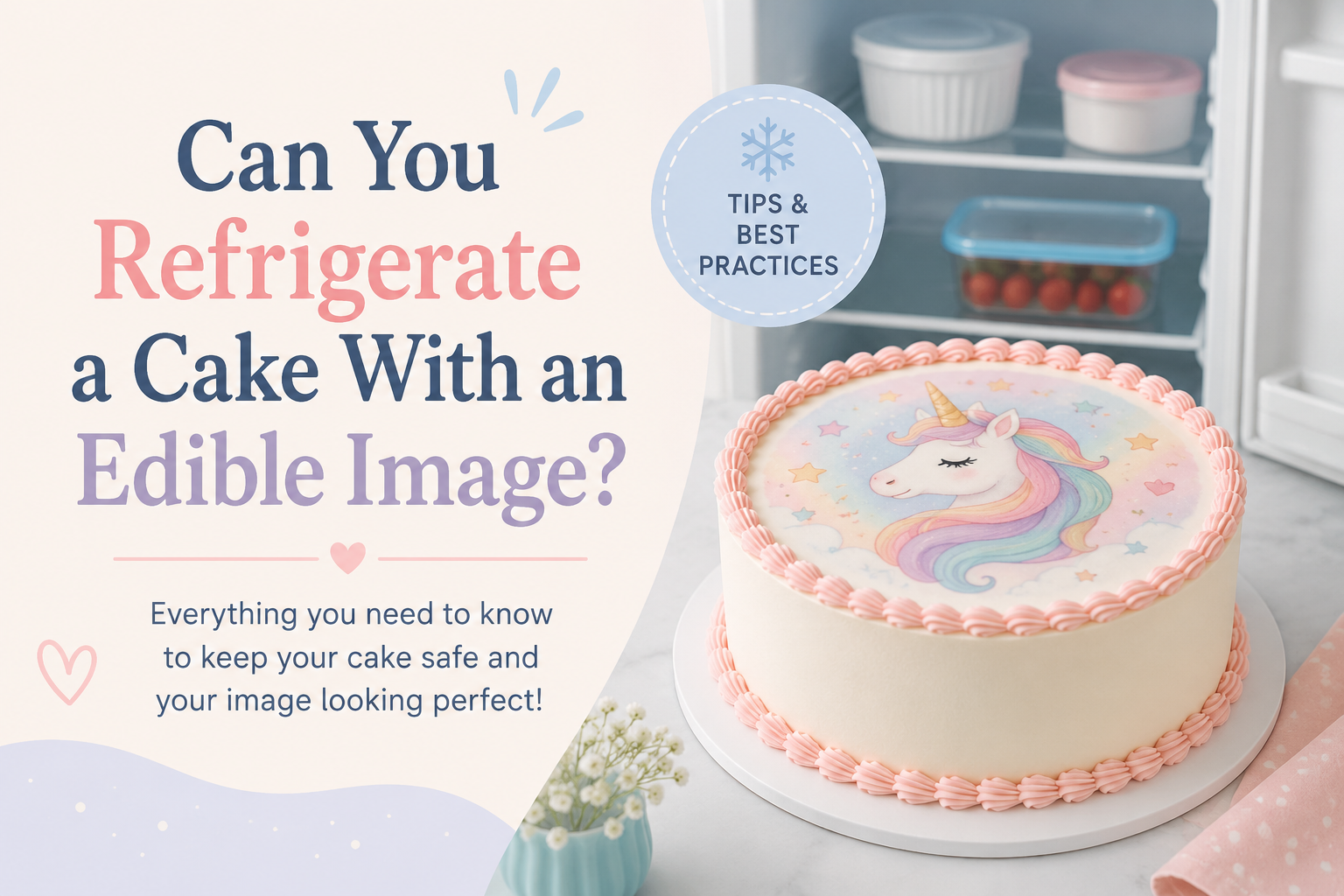
Can You Refrigerate a Cake With an Edible Image? Expert Storage Guide
Can You Refrigerate a Cake With an Edible Image? Here's the Full Answer
Short answer: yes — but how you wrap it, when you unwrap it, and what kind of edible image you used all decide whether your design comes out crisp or comes out crying.
If you've ever pulled a beautifully decorated cake out of the fridge only to find your edible photo curling, sweating, or bleeding color onto the buttercream — you're not alone, and it's not your fault. It's almost always a storage step, not the image itself. Below, we'll walk through exactly what happens to wafer paper and frosting sheets in the fridge, and the simple routine that keeps every custom edible image looking freshly printed, even three days later.
In this guide
The Quick Answer
Refrigeration doesn't damage edible images on its own — moisture does. As long as the cake is properly chilled before the image is fully set, sealed against condensation, and brought back to room temperature gradually before unwrapping, a high-quality edible image will look just as sharp coming out of the fridge as it did going in.
That said, "properly" is doing a lot of work in that sentence — so let's break down exactly what that means, starting with what you're actually putting on the cake.
What Is an Edible Image Actually Made Of?
Every edible topper starts life as edible paper run through a food-safe printer with edible ink. The two most common bases are wafer paper and frosting sheets (icing sheets), and the difference between them is the single biggest factor in how each one behaves in cold, humid environments like a refrigerator.
Wafer Paper
Made from potato starch, water, and oil — thin, light, slightly brittle, and almost translucent. It's low-moisture by nature, so it tolerates the fridge well, but it's more sensitive to humidity once exposed to open air, and can curl at the edges if it dries out too fast.
Frosting Sheets
Built on a sugar-and-cornstarch base, frosting sheets are thicker, glossier, and designed to "melt" smoothly into buttercream or fondant. They're sturdier in the fridge but more prone to absorbing surface moisture if left unwrapped, which is what causes that dull, slightly tacky look.
Every edible image sold on Custom Edible Sheets is printed to order on premium-grade stock specifically chosen for color retention and fridge stability — which is part of why our customers can chill their cakes days in advance without losing detail.
Why Cold Air Actually Affects an Edible Image
Here's the part most cake tutorials skip: your refrigerator isn't just cold, it's a moisture machine. Every time the compressor cycles, it pulls humidity out of the air and that moisture condenses onto the coldest surface available — which, the moment you open the door, becomes your cake. That thin layer of condensation is the actual enemy, not the temperature itself.
When that moisture lands on a frosting sheet, the sugar layer on the surface starts to dissolve, and edible ink is water-soluble by design (so it sits cleanly on the page). The result is the classic "bleeding" look — colors smudging into each other or running into the buttercream underneath. Wafer paper handles condensation slightly better because it has less surface sugar to dissolve, but enough moisture will still make it go soft, wavy, or translucent in patches.
The real rule of thumb: it's not the cold that ruins edible images — it's uncontrolled condensation during chilling and, even more often, during the unwrapping step when the cake meets warm room air too fast.
Wafer Paper vs. Frosting Sheets: Fridge Performance
| Factor | Wafer Paper | Frosting Sheets |
|---|---|---|
| Moisture sensitivity | Moderate — best wrapped airtight | Higher — sugar surface absorbs humidity fast |
| Color vibrancy after chilling | Slightly muted if exposed to air | Stays vivid if sealed properly |
| Texture risk | Can curl or go brittle if dried out | Can turn tacky or "melt" if too wet |
| Best surface to apply to | Buttercream, ganache, royal icing | Buttercream, fondant, chocolate |
| Recommended max fridge time once applied | 3–4 days, sealed | 4–5 days, sealed |
Step-by-Step: How to Refrigerate a Cake With an Edible Image
Let the image set before it goes anywhere near the fridge
Apply the edible image, gently smooth out air bubbles, and let it sit at room temperature for 10–15 minutes so it adheres fully to the buttercream or fondant. Refrigerating it while it's still "wet" from application traps moisture underneath, which is one of the most common causes of edges lifting later.
Box it — don't just cover it with cling film
Plastic wrap pressed directly against an edible image is asking for smudged ink, since condensation forms right where the plastic touches the surface. Use a proper cake box, a cake carrier with clearance above the image, or a tented sheet of wax paper held up with toothpicks so nothing actually contacts the printed surface.
Keep it on a middle shelf, away from the vents
The back wall and the vents nearest the compressor are the most humid, most temperature-volatile zones in any fridge. A middle or upper shelf, away from direct airflow, keeps the environment around your cake more stable.
Bring it back to room temperature slowly, still covered
This is the step almost everyone skips — and the one that causes the most damage. Take the cake out of the fridge and leave it in its box, still sealed, for 30–60 minutes before opening it. If you unwrap a cold cake immediately, warm room air hits the cold surface and condenses instantly, right on top of your image. Letting the whole package warm up together means the moisture forms on the box, not the cake.
Pat, don't wipe, if you do see light condensation
If a little moisture does appear once you open the box, blot it gently with a dry paper towel — never wipe in a sweeping motion, which can smear edible ink instantly. Most light condensation evaporates on its own within a few minutes once exposed to room air.
Can You Freeze a Cake With an Edible Image?
You can — but it's a bit less forgiving than the fridge. Freezing is fine for the cake itself, and many bakers freeze decorated cakes successfully for special-occasion prep. The risk with edible images is specifically at the thaw stage: ice crystals form on the surface during freezing, and as those crystals melt, they release a more concentrated dose of moisture than standard fridge condensation ever would.
If you do need to freeze a cake with an edible image already applied:
Freeze first, decorate after
Whenever possible, freeze the plain, undecorated cake or just the crumb-coated cake, then thaw fully and apply the edible image right before serving. This avoids the thaw-condensation problem entirely.
If it must be frozen as-is
Freeze it uncovered for 1–2 hours first so the surface hardens, then wrap loosely without touching the image, and thaw it slowly in the fridge overnight rather than at room temperature — slow, cold thawing produces far less surface moisture.
Common Mistakes That Ruin Edible Images in the Fridge
Wrapping cling film directly on the image
Creates a sealed pocket of condensation right against the print — the #1 cause of smudged designs.
Unwrapping straight from the fridge
Warm air meeting a cold surface instantly = condensation on your edible image, every single time.
Applying the image while the cake is still warm
Warm buttercream releases steam as it cools, which gets trapped under the image and causes bubbling later.
Storing near the fridge door or vents
Temperature swings every time the door opens create repeated, low-level condensation cycles.
How Long Does a Cake With an Edible Image Last in the Fridge?
Properly sealed and stored away from vents, a cake with a wafer paper topper holds its detail for about 3–4 days, and a frosting sheet topper for about 4–5 days, before color vibrancy starts to fade or texture begins to soften. Both timelines assume the buttercream or filling underneath is itself fridge-stable for that long — always default to the storage guidance for your specific filling (cream cheese, whipped cream, mousse, etc.) if it's shorter than the topper's own window.
Want an Edible Image Built to Survive the Fridge?
Every design from Custom Edible Sheets is printed on premium, fridge-tested stock with edible inks chosen for color hold — so you can decorate days ahead without the guesswork.
Frequently Asked Questions
Will refrigerating ruin the colors on my edible image?
No, cold temperature alone doesn't affect ink color. Color loss almost always comes from condensation dissolving the surface, which is why proper boxing and a slow return to room temperature matter so much more than the fridge setting itself.
Should I refrigerate the cake before or after applying the edible image?
Apply the image first, let it set at room temperature for 10–15 minutes so it bonds to the frosting, then refrigerate. Putting a cold cake straight into a humid kitchen to decorate can cause its own condensation problem before you've even started.
How long should I let the cake sit out before unwrapping it?
30–60 minutes, still sealed in its box, is the standard recommendation. Larger or multi-tier cakes may need closer to an hour for the temperature to equalize evenly.
Can I use plastic wrap at all?
Yes, but only as an outer layer around the cake box or carrier — never pressed directly against the printed surface of the edible image itself.
Is wafer paper or frosting sheet better for a cake that needs to be refrigerated for several days?
Frosting sheets generally hold up marginally longer in the fridge thanks to their thicker base, but both perform well for 3+ days when sealed correctly. The bigger factor is almost always storage technique rather than the material itself.
My edible image got slightly wavy in the fridge — can I fix it?
Light waviness from minor condensation often relaxes on its own as the cake returns to room temperature. If it doesn't fully smooth out, gently smoothing from the center outward with clean, dry hands can help reset it against the frosting.