

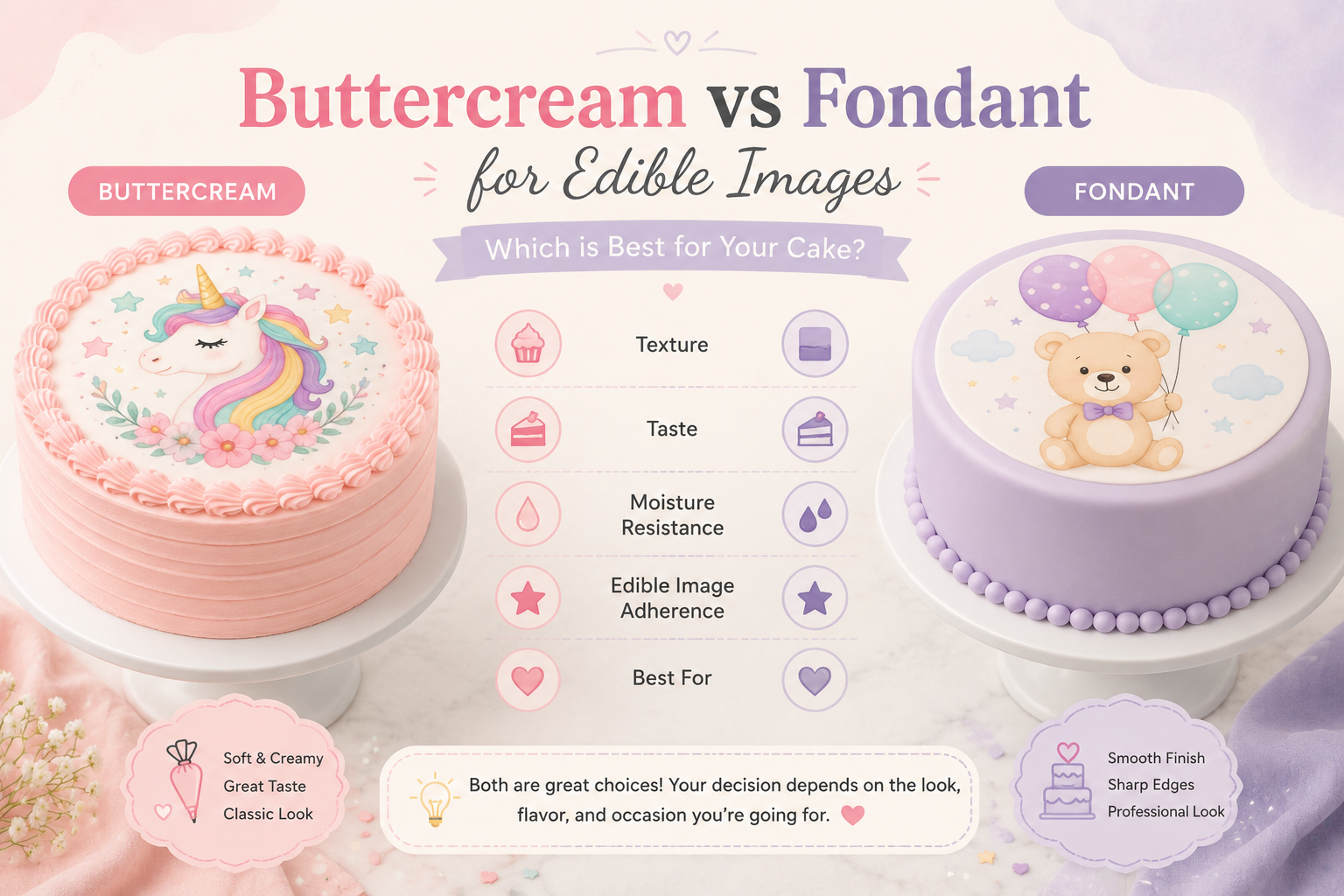
Buttercream vs Fondant for Edible Images: Which Works Best?
Buttercream vs. Fondant for Edible Images: Which Should You Use?
Both surfaces can carry a crisp, full-color edible image — but they behave very differently once the topper goes on. Here's exactly how to choose, and how to apply it right for the surface you pick.
If you're staring at a cake order trying to decide whether to crumb-coat in buttercream or roll out fondant before your custom edible image cake topper goes on, you're asking the right question first. The base underneath an edible image affects how smooth it looks, how long it holds up, and how forgiving the application process is — and getting it wrong is the #1 reason images bubble, wrinkle, or slide.
In this guide
The Quick Answer
Buttercream gives an edible image a soft, homestyle finish and is the faster, more forgiving option for most home bakers. Fondant gives a perfectly flat, hard, true-to-print canvas that produces the sharpest possible image clarity and holds up best for travel, warm weather, and multi-day display — at the cost of more prep time and skill.
Buttercream: Pros and Cons for Edible Images
Buttercream is the surface most home bakers already know, and it's a genuinely good match for edible images as long as it's chilled and smoothed correctly first.
Pros
- Faster to prep — no rolling, no resting time
- Soft, classic mouthfeel under the topper
- No special tools or fondant skills required
- Easier to patch or touch up last minute
Cons
- Surface must be chilled and smoothed perfectly flat or the image will show every ridge
- More sensitive to heat — soft buttercream can let an image slide
- Slightly shorter "crisp" display window outside the fridge
Fondant: Pros and Cons for Edible Images
Fondant's hard, even surface is essentially a printer-flat canvas, which is exactly why professional cake studios reach for it on detailed photo cakes and logo toppers.
Pros
- Perfectly smooth, hard surface = the sharpest possible image clarity
- Far more heat and humidity stable for outdoor events or travel
- Holds shape and edges cleanly for several days on display
- Ideal for tiered, wedding, and corporate-logo cakes
Cons
- Takes more time, tools, and practice to roll and cover smoothly
- Firmer, denser bite that not every guest prefers
- Harder to fix once applied — mistakes mean re-rolling
Side-by-Side Comparison
| Factor | Buttercream | Fondant |
|---|---|---|
| Prep time | Low — chill and smooth | Higher — roll, cover, smooth, rest |
| Surface flatness | Good, with care | Excellent, naturally flat |
| Image clarity | Very good | Best possible |
| Heat/humidity tolerance | Moderate | High |
| Best for | Home bakes, birthdays, last-minute orders | Weddings, tiered cakes, logos, outdoor events |
| Skill level needed | Beginner-friendly | Intermediate to advanced |
How to Apply an Edible Image on Buttercream
Smooth the buttercream as flat as possible
Use a bench scraper or hot spatula for a glass-smooth finish — every ridge or air pocket will show through a frosting sheet topper.
Chill the cake for 15–20 minutes
A firm, cold surface holds the image in place immediately and prevents it from sliding while you position it.
Peel and place from the center out
Lay the center of the image down first, then smooth outward with a fondant smoother or clean dry fingers to push out air bubbles.
Let it set for 10–15 minutes before moving the cake
This gives the image time to fully bond to the buttercream surface.
How to Apply an Edible Image on Fondant
Cover the cake and let the fondant firm up slightly
15–30 minutes of rest gives the fondant just enough surface tack to grip the image without being tacky enough to trap air.
Lightly mist or brush the surface with water
A very thin, even layer of water (or a touch of piping gel) reactivates the back of the edible image so it adheres cleanly to fondant.
Apply from one edge, not the center
Lay one edge down and roll the image across the surface, smoothing as you go — this pushes air out ahead of the image instead of trapping it underneath.
Smooth with a fondant smoother, not fingers
A smoother applies even pressure across the whole surface and avoids leaving fingerprint marks on the fondant edges.
Which Should You Choose?
Choose buttercream if…
- You need the cake done quickly
- It's a birthday, home celebration, or casual event
- You and your guests prefer a softer bite
- The cake will be served same-day
Choose fondant if…
- It's a wedding, corporate, or logo cake
- The cake needs to travel or sit out for hours
- You want the absolute sharpest image clarity
- It's a hot or humid event venue
Either way, the topper matters as much as the technique. A custom edible image cake topper printed on premium frosting sheet stock is flexible enough for buttercream and crisp enough to lie perfectly flat on fondant — so you're never fighting the material, just the technique.
Common Mistakes to Avoid
Applying to warm buttercream
Warm frosting is soft enough to let the image slide or wrinkle before it sets — always chill first.
Over-wetting fondant
Too much water turns the fondant surface sticky and tacky instead of just adhesive, which traps air under the image.
Smoothing with dirty or damp fingers
Leaves visible marks and smudges on both buttercream and fondant — always use clean, dry tools.
Skipping the rest time
Moving or boxing the cake before the image fully bonds is one of the top causes of lifted edges in transit.
Ready to Print Your Design?
Upload any photo or logo and get a personalized edible frosting sheet, cut and printed to order — built to lie flat on buttercream and fondant alike.
Frequently Asked Questions
Can I put an edible image directly on fondant without water?
It's not recommended — a very light misting or brushing of water (or piping gel) is what activates the image's adhesive backing. Without it, the image is more likely to shift or lift at the edges.
Does buttercream need to be a certain type for edible images to stick?
Any standard American or Swiss meringue buttercream works well once it's smoothed flat and chilled. Whipped or very soft buttercreams should be firmed up in the fridge first.
Which option looks more "photo-realistic"?
Fondant generally produces the crispest, most photo-realistic result because its hard, flat surface has zero texture interference. Buttercream still looks very good — just slightly softer at extreme close range.
Can I apply an edible image over fondant that's already covering a cake for a day or two?
Yes, as long as the fondant surface is still smooth and hasn't dried out or developed a hard crust, which can prevent the image from adhering evenly.
Is one option better for outdoor summer events?
Fondant, by a clear margin. Its firmer structure resists heat and humidity far better than buttercream, which can soften enough to compromise the topper.
Do I need a different edible image for buttercream vs. fondant?
No — a standard frosting sheet edible image works on both surfaces. The difference is entirely in how you prep the surface and apply it, not the topper itself.